Pages

Monday, May 13, 2019

crystals

Aim: To learn about a saturated solution and how to make crystals
Definition of solution
A liquid mixture, when something is dissolved into a liquid (eg: sugar in water) 

Definition of saturated
Having or holding as much as can be absorbed of something (when no more sugar or borax can be dissolved into the water)


In groups of three you will make three different types of crystals and compare the results.


Image result for borax crystals

Ratio; 3 Tablespoons Borax per 1/2 cup water

Materials

1)Cups
2)pipe cleaners
3)borax
4)peg
5)

Process

Step 1: 3 table spoons into cup
Step 2:pour 1/2 a cup of warm water
Step 3:start stiring until dissolved/will come back again
Step 4: make a star out of small pipe cleaners
Step 5:hang star on peg
Step 6:dip into solution with peg hanging in the inside not touching water

Sugar Crystals

Grow your own Sugar Crystals

Ratio: 1 cup sugar to 1/2 cup water

Materials

1)sugar
2)cup
3)string
4)popsical stick
5)

Process

Step 1: 1 cup of sugar
Step 2: 1/2 a cup of warm water
Step 3: start stiring until dissolved
Step 4:tie your piece of string onto the popsical sick
Step 5: submerge it into the solution
Step 6:
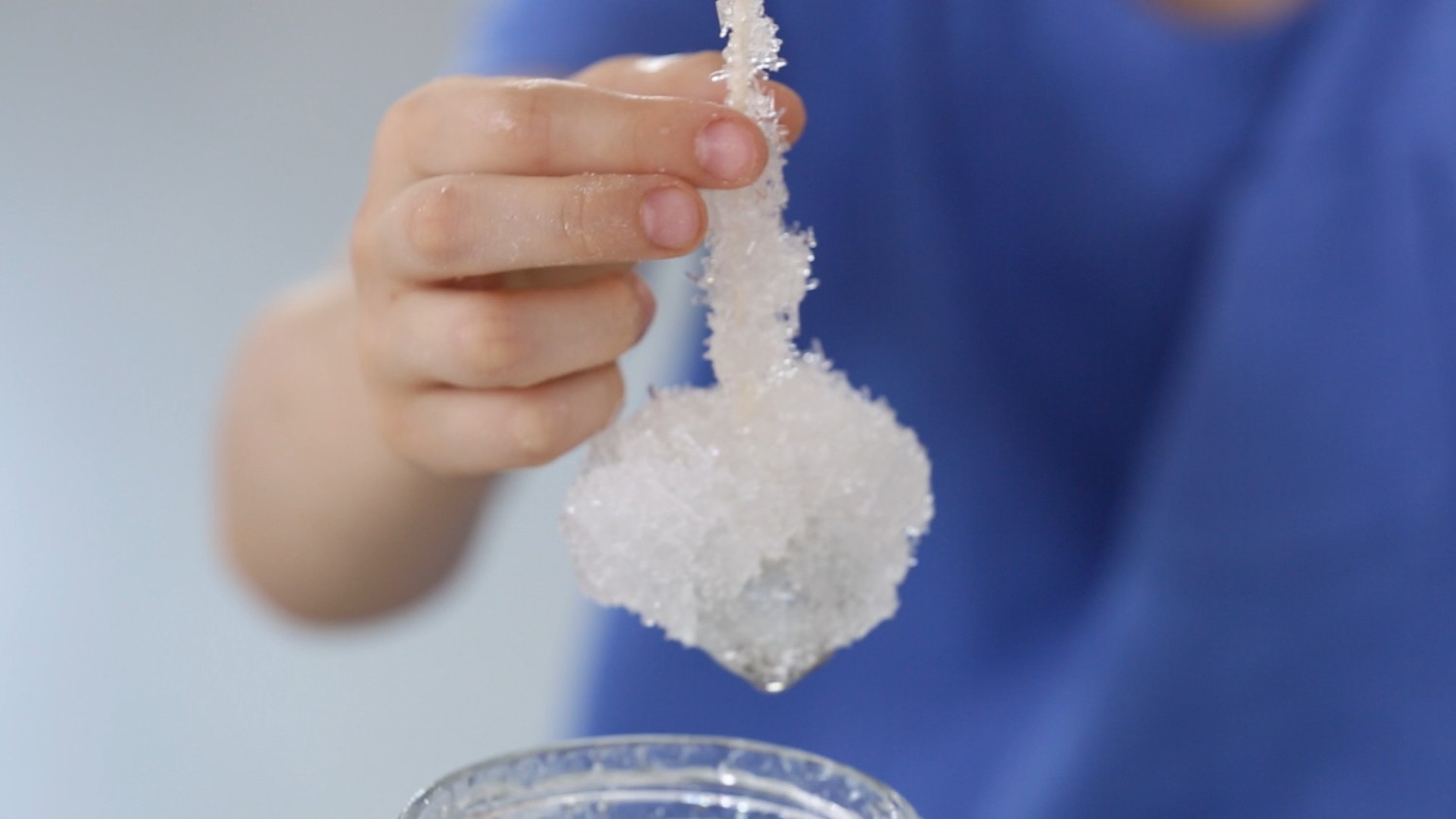


Image result for how to make salt crystals

Ratio: 4 Tablespoons salt to 1/2 cup water

Materials

1)salt
2)popsical stick
3)cup
4)string
5)

Process

Step 1:4 table spoons into cup
Step 2:pour 1/2 cup of warm water
Step 3:start stiring until dissolved
Step 4:tie string onto popsical stick
Step 5:submerge it into solution
Step 6:


Findings

Describe your crystals in the table below.


Crystal Type
Shape
(Describe the shape)
Size
(of individual crystals)
Hardness
(Crumbly to Rock Hard)
Borax


Sugar


Salt


What crystals worked out best and why?:

Conclusion:

________________________________________________________________________


After watching the videos as a class, explain how the following crystals are formed:


Type
Explanation
Salt
Water flows threw into little ponds. The water heats up and boils until it is nothing but gas.The gas rises up into the air since it had heated up and dried up in the pond.The salt is than left in the little pond hole.
Sugar
Sugar is made from a plant. The plant is called a sugar cane. Raw sugar is sucrose which is extracted from sugar cane or sugar beet. The sugar syrup is concentrated by boiling and than cooled and seeded with sugar crystal's causing the sugar to crystallize out.
Snowflakes
A snowflake begins to form when a extremely cold water droplet freezes onto a pollen or dust particale in the air/sky. This then creates an ice crystal. As the ice crystal falls to the ground water vapor freezes onto the primary crystal buiding new crystals - the six arms of the snowflake.


CRYSTAL TYPES


AIM: TO LOOK AT THE 7 DIFFERENT TYPES OF CRYSTALS


Image result for salt crystal image
Salt Crystals

Image result for sugar crystal image
Sugar Crystals

Image result for borax crystal image
Borax Crystals


7 different crystal shapes


The 7 types of crystals


Type
Number of sides
2 examples
Image
Triclinic

6

albite

rhodnite
Image result for rhodonite
Monoclinic


10

gypsum

mica

Image result for gypsum
Orthombic


6sulfar
topaz
Image result for topaz
Triganol


10albite
rhonite
Image result for albite
Hexagonal


8beryl
cinnabar
Image result for beryl
Cubic


6galena
fluorite
Image result for fluorite
Tetragonal


12chalcopyrite
rutile
Image result for chalcopyrite

Monday, May 6, 2019

Drama - Hurumano

Drama - Hurumano

Hi guys and welcome back to my blog. Today I will be talking about drama and what we have done while doing it this week. The thing that I will be talking about exactly is a food pyramid. The food pyramid is about eating healthy food. The teacher didn't tell us what a food pyramid is so we had to make one of what we thought it looked like. The one that I made looked way different then to what the teacher did.
This is the one that I made. Its not finished yet but this is what I have.


And this is what it really looks like.
Image result for food pyramid
I didn't do it this way because I really wasn't sure how it looked.
We also listened to a healthy eating song.
This was what we did on Tuesday

And this is what we did today

We made a donut made out of people and told them our first name and also told them what we did in the holidays that was fun. I didn't really enjoy this one. It wasn't as fun as the other ones we did not doing the donut because that was the first time we did it.

The outer ring people didn't have enough people so I ended up having and imaginary person in front of me.

Thank you for reading this blog post
Please comment and give feedback
Bye

Examples of what a filter is

Examples of what a filter is


A filter is something that removes bad bacteria

Aim: To make a filtration plant using household materials.

Image result for filtration science experiment
Water Filtration Plant

What is filtration?


Filtration is separating solids from liquids by adding a medium through which only the liquid can pass. 

Examples are: 

  1. Fish tank filter
  2. Pool filter
  3. Cleaning filter
  4. Kettle filters

Materials

1.Filter paper
2.funnel
3.Sand
4.Water bottle
5.Scissors
6.Rocks
5.Dirty water
6.

Process - ( use verbs or doing words in each step )


Step 1

Cut the top of the bottle off and save it for later when you next use it for this

Step 2

Put the top half upside down in the bottle

STEP 3

Add layers of sand and rocks but first you need to make a funnel made out of filter paper 

STEP 4

Get 1 cup of dirty water 

STEP 5

Pour dirty water into the funnel and watch it turn clear

Findings
 Half of the water filtered through this minute. In the other minute the rest of the water came running through. It started to drip a lot and than in the 50s in the 3 min it started to stop.            
Drops per minute: over 30
Water colour: Still dirty

Write a short sentence about the water every 1 minute. 
Include 'How much water has filtered through', 'How fast it is dripping through', and 'How clear the water is'.

Minutes                          1.    Half of the water filtered through this minute                     2.     In the other minute the rest of the water came running through              3.   It started to drip a lot and than in the 50s in the 3 min it started to stop                 4.                       5.
Drops per minute: over 30
Water colour: Still dirty
Conclusion:
Our water didn't really turn clear than to what we had expected. It just stayed dirty which was a shame. I thought that there was only going to be a few drops but instead there was over 30 drops. It went on for almost 4 minutes. It did start to clear up but it was still a little bit dirty. 

White powder test

Today you will be a Forensic Chemist. 
A bag of white powder has been confiscated by the airport customs.  You need to find out what white powder it is?

Aim: To see what different powders and liquids react in different ways / also to find out what the white powder is.

There are  a number of different white powders in our everyday life. Some of these are harmful and others are not. Test the four white powders listed to see which one has been found at the airport.

Here are some examples of everyday kitchen white powders.

Flour, Cornflour, Sugar, Salt, Baking Soda, Baking Powder, Icing Sugar, Tartaric Acid

Citric Acid, Gluten Free flour

You will be given a small amount of 4 white powders on your cardboard. On the black cardboard using a magnifying glass look at the powders.
Look at them under your magnifying glass and record what you see. 

These are the four powders we will be using. Upload a photo of each powder. 

1.  Cornflour
2.  Baking Soda
3.  Salt
4.  Sugar 

Before you add the iodine, vinegar or water you will need to divide each powder into 3.

Materials

1.  Black cardboard
2.  vinegar
3.  water
4.  iodine
5.  salt
6.  sugar
7. cornflour
8. baking soda
9.pipette

Steps

1. Fold the cardboard in four
2. Get a little bit of the salt, baking soda,sugar and cornflower and add a little bit of every thing and put one powder in each four square's. make sure that the powders are not touching.
3. One you have add in the powders you than have to divide them into quarters
5. After you have got the vinegar, water and iodine you then add 3 drops into one quarter and watch it work its way
6. Than you just watch and see what happens.
The names of the powders are called, Sugar, salt, baking soda and corn flower.
All of them had  different reaction.


Findings:


Sugar
Salt
Baking Soda
Cornflour
Appearance
whitewhitewhitewhite
Texture
grainy/biggrainy/mediumsmallsmall
Smell
nothingnothingnothingnothing
Iodine
still wet/darkerwent lighterwent hardturned black/hard
Water
soggy
absorbs
wasn't so soggydidn't really make a reaction.went hard .
Vinegar
Didn't do  reactionabsorbsbig bubbleswent hard

Write a paragraph about your findings.

All of the powders were the colour white. With the powders being white I think that it was easy to see the colours and how they react. When we were looking at the powders some of them were big and small and some in between for the grains. The biggest one would of had to be the sugar. All of the powders smelled like nothing, they didn't have any smell to them. The iodine had lots of different results and reactions.

At the end we got to do a mystery powder. The powder was the baking soda. The reason why I thought it was the baking soda was because it wasn't grainy and it wasn't soft like the cornflour so that's why I thought that it was the baking soda.

Iodine:
Take cornflower for a example : When we added in the iodine into the corn flower it made it hard and the colour went a dark and rich black
Here's another example: When we added in the iodine for the salt, the iodine went a light brown maybe even caramel colour. When we added it into the cornflour and baking soda it didn't do any reaction.

Water:
The water on all of them had a really weird reaction. With the water I didn't think that it would have a reaction to it. When we added the water onto the sugar it went all soggy and gross. When we added it into the salt it went soggy but not as soggy and it did with the sugar. With the baking soda it didn't have any reaction to it at all. I was hoping that it did but it had nothing. Last one for the water is the cornflour. I wasn't expecting this to happen to it but when we added in the water to the cornflour it went hard and went to like a milky white colour. 

Vinegar:
When we added the vinegar into the sugar it had no reaction to it. it did nothing except absorb the sugar. That was it. The salt did the same thing as it did with the sugar. Had no reaction to it and only absorbs it. When we added it into the baking soda it started to fizz and make bubbles. The last one now is the cornflour. When we added it in it did the same thing as it did with the water. It went hard and made a milky colour.


Over all I really enjoyed doing this experiment and would love to do it again just with different powders and maybe even liquids.

Thank you for reading this blog post. I know it was long but that's just how I sometimes like it. Don't forget to comment and give feedback.